

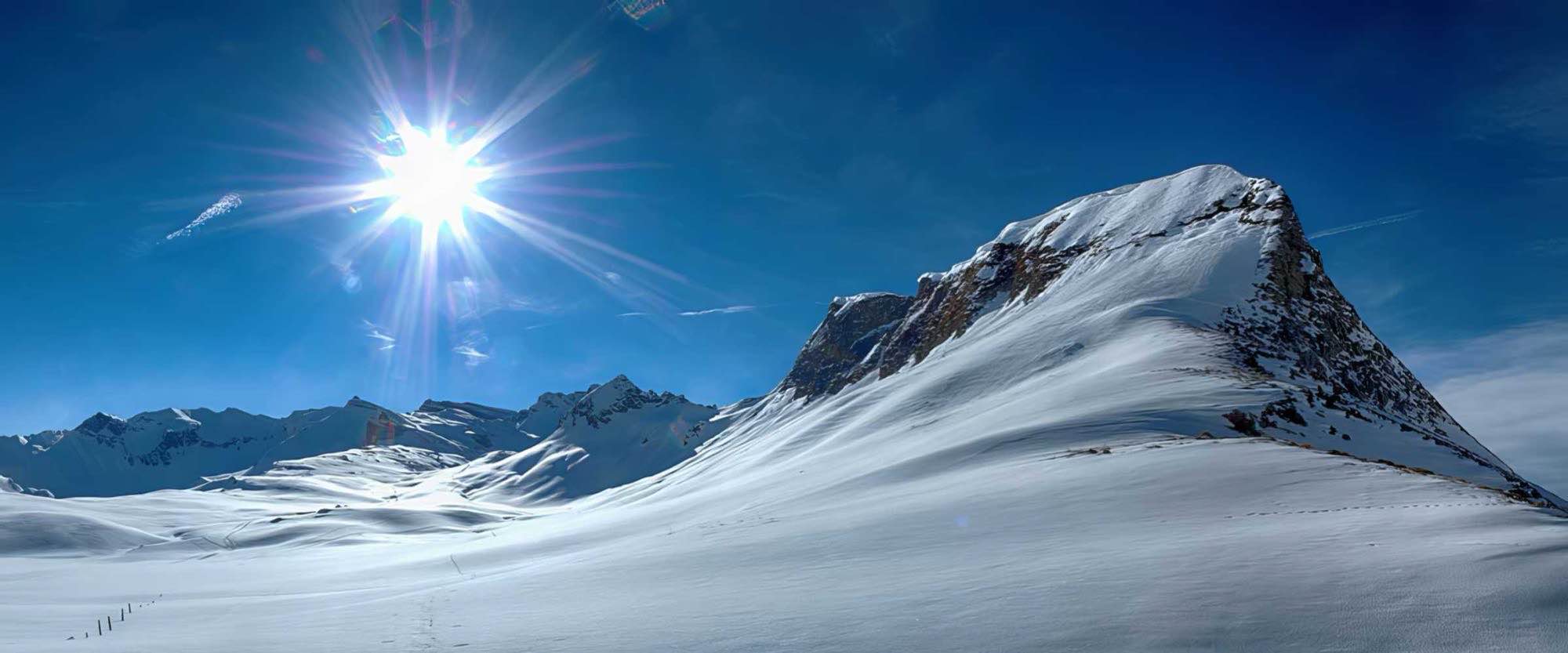
Sun and shade in Interlaken
Interlaken (BE, 567 m): on the shortest day the sun shines in the centre (Höheweg) from 10:00 to 15:52, for 5 h 52 min; without the mountains it would be 8 h 30 min.
- 5 h 52 min21 Decemberdirect sun, 10:00–15:52
- 14 h 00 min21 Junedirect sun, 06:06–20:06
- 1,807 hPer yearexpected with the weather
- 735 hTerrain takesa year, hills and mountains
Horizon and sun paths
Grey: the horizon of Interlaken (terrain up to 50 km). The lines show the path of the sun on 21 December, 21 March and 21 June; dotted where it is behind the mountains. The dots with a time show when the sun clears the mountains and when it disappears.
What hides the winter sun
In winter the sun stands low in the south. In that direction the horizon of Interlaken reaches 16.7° (direction SE, 5.0 km away, Tuba, 2,076 m). On 21 December the terrain takes 2 h 38 min of sun.
With the weather
A plain sun-position calculator only shows when the sun is above the horizon, as if every day were cloudless. In Interlaken that would be 3,712 hours a year. suntag.ch also counts the weather: in each month, only the share of sun that the MeteoSwiss stations of the region actually measured from 2011 to 2025 counts. That leaves about 1,807 hours. For comparison, the station Interlaken (1.8 km away) measures 1,680 hours a year on average, with its own horizon. For a given address, the report calculates this day by day, with nearby buildings, trees and the floor.
| Hours a year | Share | |
|---|---|---|
| Without mountains or clouds | 4,447 h | 100 % |
| Mountains take | − 735 h | − 17 % |
| Weather takes | − 1,905 h | − 43 % |
| Expected sun | 1,807 h | 41 % |
What these figures do not show
The calculation is for a point in the centre (Höheweg), with the terrain only. On a slope, on the valley floor or behind a neighbouring house the sun can go an hour earlier or later. For a given address the report includes nearby buildings, trees and the floor.
The sun in other places
- Basel
- Bern
- Biel/Bienne
- Chur
- Davos
- Genève
- Grindelwald
- Lausanne
- Locarno
- Lugano
- Luzern
- Montreux
- Sion
- St. Gallen
- St. Moritz
- Thun
- Winterthur
- Zermatt
- Zug
- Zürich
The sun at your address
The suntag.ch report calculates every hour of the year at your address, with nearby buildings, trees and the floor, plus noise, air, transport and natural hazards: 38 pages in about 10 seconds, from CHF 15.
Frequently asked questions about the sun in Interlaken
How many hours of sun does Interlaken get in winter?
On 21 December the sun shines in the centre of Interlaken for 5 h 52 min, from 10:00 to 15:52. Without the mountains it would be 8 h 30 min.
How many sunshine hours does Interlaken get a year?
Without clouds, 3,712 hours are possible in the centre; with the weather, about 1,807. The station Interlaken measures 1,680 hours a year.
Does every address in Interlaken get the same sun?
No. Slopes, valley floors, neighbouring houses and trees shift sunrise and sunset by an hour and more. The suntag.ch report calculates it for a given address and floor.
More guides
- Sun exposure and sunshine hours
- Sunshine hours by city
- Noise: road, rail, aircraft
- Connectivity: transport, fibre, 5G
- Antennas, power lines, nuclear plants
- Building zones and population density
- Natural hazards: earthquakes, radon, avalanches
- Sample report: all pages
- Method and data
- suntag.ch in AI assistants
- Property checklist for Switzerland
Sources and method: Terrain: swisstopo (DHM25, DHM50, DHM200) and Copernicus GLO-90; sunshine: MeteoSwiss, stations 2011–2025; calculated as in the report, see Method and data. As of 2026-11-20.